Scientific Evidence
March 2026
Assessment of Fractional Flow Reserve from Coronary CT Angiography Using a Deep Learning-Based Algorithm:
This multicenter retrospective study evaluated the diagnostic performance of a deep learning–based algorithm for the non-invasive estimation of fractional flow reserve from coronary CT angiography (CCTA), using invasive physiological measurements as the
reference standard. The model demonstrated high diagnostic accuracy for detecting
hemodynamically significant coronary artery disease (per-patient AUC = 0.935; sensitivity = 93.2%; specificity = 93.7%; accuracy = 93.3%).

Scientific Evidence
January 10th 2025
This study aim to evaluate the diagnostic performance of a DLM for quantifying coronary stenosis on computed tomography coronary angiography (CTCA) using the Coronary Artery Disease-Reporting and Data System (CAD-RADS).

Scientific Evidence
March 10th 2024
Diagnostic performance of deep learning to exclude coronary stenosis on CT angiography in TAVI patients
This study aimed to evaluate the performance of CorEx in classifying coronary artery stenosis in patients eligible for Transcatheter Aortic Valve Implementation (TAVI), making it possible to avoid unnecessary invasive coronary angiography.


Scientific Evidence
February 2025
The purpose of this study was to evaluate the diagnostic performance of automated deep learning in the detection of coronary artery disease (CAD) on photon-counting coronary CT angiography (PC-CCTA).

Scientific Evidence
October 7th 2024
Artificial intelligence‐enhanced detection of subclinical coronary artery disease
in athletes: diagnostic performance and limitations
This study aim to evaluate the diagnostic performance of AI-based CCTA for detecting
CAD and assessing FFR in asymptomatic male marathon runners.

Scientific Evidence
February 16th 2024
Coronary artery disease evaluation during transcatheter aortic valve replacement work-up using photon-counting CT and artificial intelligence
This study aimed to evaluate the performance of CorEx in classifying coronary artery stenosis in patients eligible for Transcatheter Aortic Valve Replacement (TAVR), using photon-counting CT.
Scientific Evidence
January 17th 2025
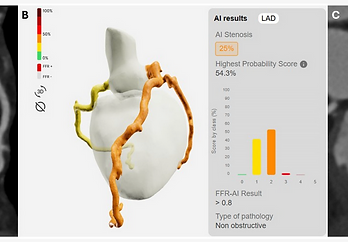
This study aimed to evaluate the performance of FFRAI model to predict positive invasive FFR and compare it to invasive FFR.

Scientific Evidence
June 22nd 2024
Invasive fractional-flow-reserve prediction by coronary CT angiography using artificial intelligence vs. computational fluid dynamics software in intermediate-grade stenosis
This proof-of-concept study aimed to compare the performance of FFR prediction
between an Artificial Intelligence solution and a Computational Fluid Dynamics
(CFD)-based software.

Scientific Evidence
September 7th 2023
Artificial intelligence-based opportunistic detection of coronary artery stenosis
on aortic computed tomography angiography in emergency department patients with acute chest pain.
This study aimed to evaluate the performance of CorEx in automatically classifying coronary artery stenosis in emergency department patients with acute chest pain, with suspicion of aortic dissection.
Our latest papers
June 22nd 2024
Freely available with unlimited access
March 10th 2024
B. Mehier, K. Mahmoudi, A. Veugeois, A. Masri, N. Amabile, C. Del Giudice, JF. Paul
February 16th 2024
JM. Brendel, J Walterspiel, F Hagen, J Kübler, JF Paul, K Nikolaou,
M Gawaz, S Greulich, P Krumm, M Winkelmann
September 7th 2023
C. Glessgen, M. Boulougouri, JP. Vallée, S. Noble, A. Platon, PA. Poletti, JF. Deux, JF. Paul
June 6th 2022
Evaluation of a deep learning model on coronary CT angiography for automatic stenosis detection
JF. Paul, A. Rohnean, H. Giroussens, T. Pressat-Laffouilhere, T. Wong,